EN
EN

Professional model boat makers transform maritime history into tangible artistry through mathematical exactitude. Every component—from hull curvature to deck fittings—must adhere to original blueprints within micron-level tolerances. At 1:100 scale, a 1mm deviation equals 10cm in reality; even a lifeboat oversized by 0.5mm can disrupt a clipper ship’s silhouette. Artisans use vernier calipers and optical comparators to verify dimensions, while accounting for material behavior—wood grain expansion, resin shrinkage during curing—before final assembly. As the International Guild of Modelmakers reports, 78% of competition disqualifications stem from proportional inaccuracies exceeding 0.05mm. This rigor separates museum-grade replicas from hobbyist builds, anchoring historical authenticity in millimeter-perfect execution.
Master craftsmen treat microscopic flaws not as quirks but as critical system failures. Under 10x magnification, they perform “triangulation checks”—measuring identical points from three angles—to detect warping invisible to the naked eye. A 2023 Naval Miniature Society study found that 92% of award-winning models underwent 12+ iterative correction cycles targeting sub-0.1mm discrepancies. This diagnostic discipline extends beyond measurement:
| Detection Method | Application | Error Prevention |
|---|---|---|
| Shadow-gap analysis | Planking alignment | Prevents hull asymmetry |
| Tension mapping | Rigging wire installation | Avoids mast deformation |
| Spectral reflection | Paint consistency | Eliminates surface texture variance |
When brass portholes deviate by just 0.08mm, their light refraction shifts—breaking the illusion of seaworthiness. In this context, obsessive scrutiny becomes signature craftsmanship: minor adjustments evolve into major quality differentiators.
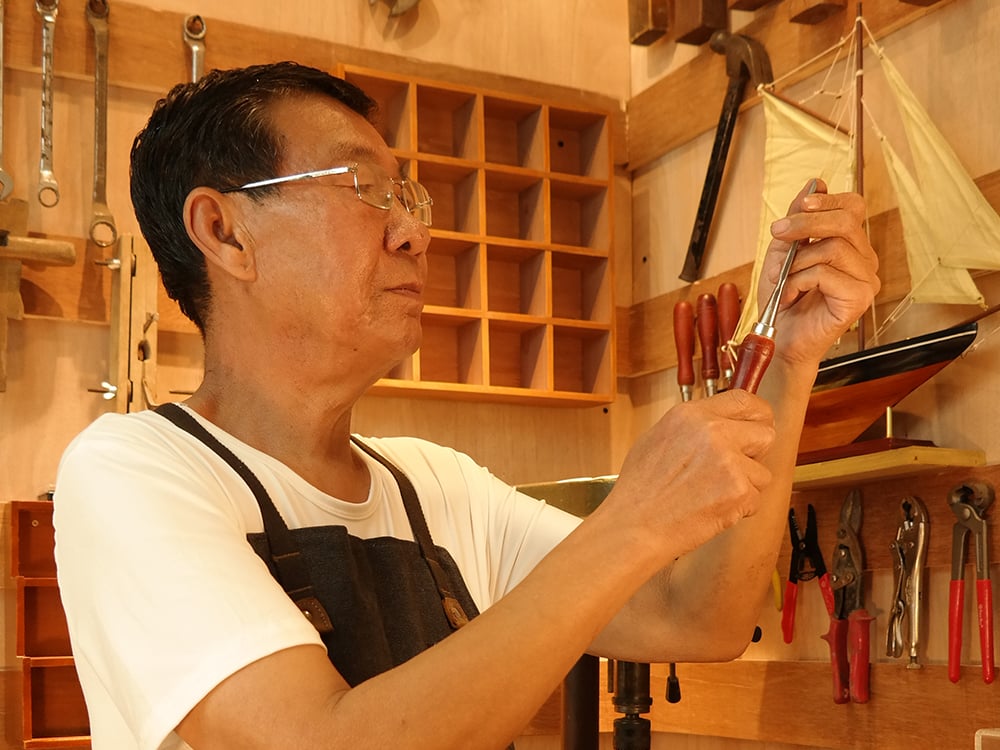
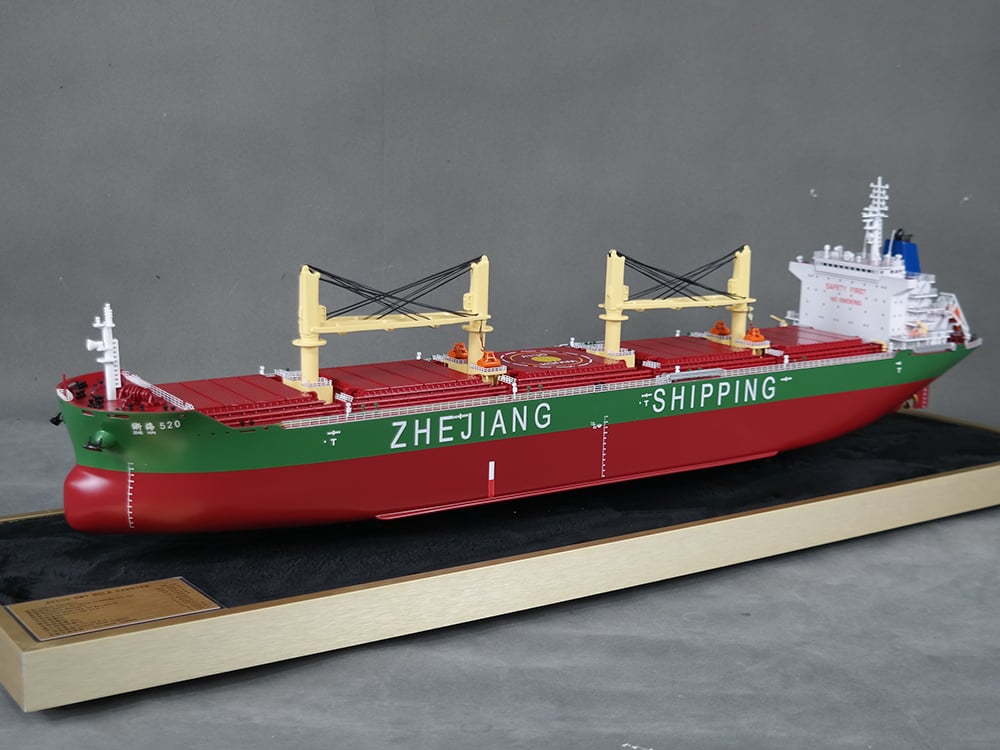
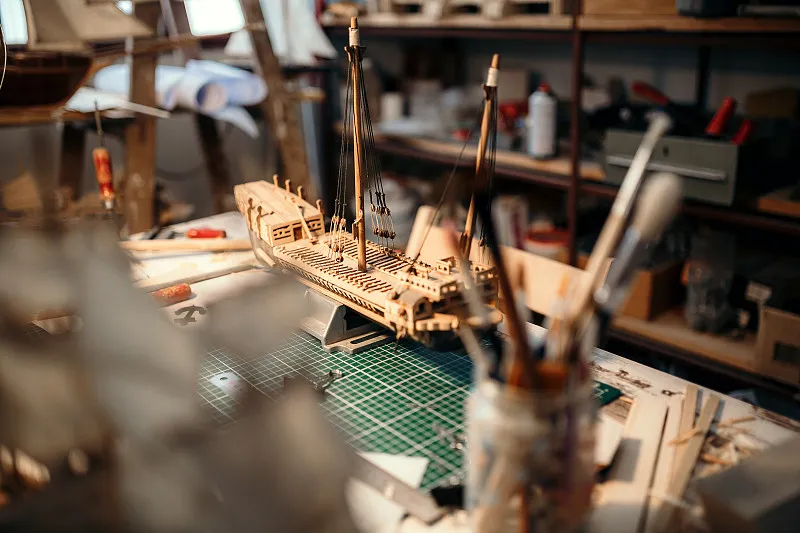
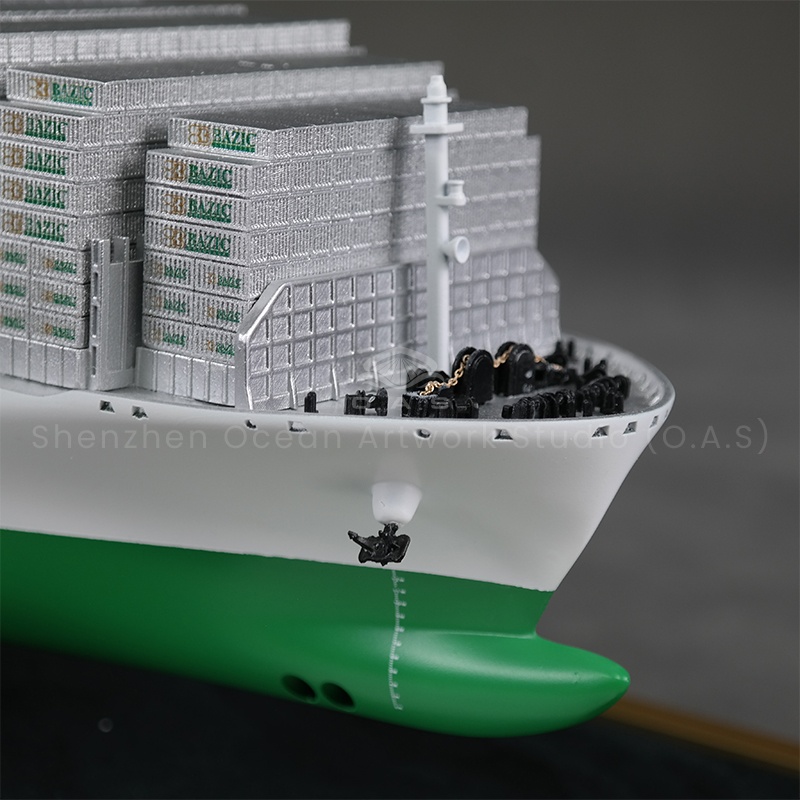
Precision knives, micro-pliers, and specialized tweezers form the core toolkit, enabling control required when shaping ABS hull contours or attaching intricate deck fittings. Ergonomic workflow design—including angled workstations and task-specific lighting—reduces hand fatigue during extended assembly sessions. Optimized setups improve fine-motor accuracy during delicate operations, such as installing branded cargo or specialized brass components. Tool organization follows construction sequencing: assembly tools are grouped separately from finishing implements, minimizing repositioning and maintaining a professional rhythm across the production phases.
Miniature block-and-tackle systems demand steady-handed threading under 5x–10x magnification, where tremors exceeding 0.2mm compromise scale fidelity. Magnifying visors or boom-mounted lenses become essential when installing sub-1mm cleats and eyebolts. Professionals employ “reverse-tension rigging”—securing lines from mast to deck before final tensioning—to prevent microscopic fraying and accommodate the material properties of high-grade ABS and synthetic components. Assembly under optics follows structural logic: permanent adhesives fully cure before temporary jigs or alignment pins are removed.
Adhesive intelligence is non-negotiable: the right bond depends on substrate compatibility, load requirements, and environmental exposure. Cyanoacrylate (CA) delivers instant strength for rigid plastics and specialized brass components but lacks the flexibility required for joints subject to significant stress. For high-grade eco-friendly ABS, solvent-based acrylic cements create a professional chemical weld that ensures structural integrity. For critical, mixed-material connections—especially resin-to-ABS or plastic-to-metal—epoxies provide waterproof, gap-filling durability with superior shear resistance, ensuring the model remains a robust vehicle for business engagement.
Substrate Pairing |
Recommended Adhesive |
Key Property |
ABS-to-ABS |
Acrylic Cement / Solvent |
Chemical weld strength |
Plastic-to-resin |
CA (Cyanoacrylate) |
Rapid curing for details |
Mixed-material joints |
Epoxy |
Superior moisture resistance |
Environmental conditions significantly affect performance: epoxy achieves optimal hardness at 25°C and requires full 24-hour curing at 60% relative humidity. This professional attention to environmental variables prevents surface defects or material separation during the assembly process—ensuring that these high-precision replicas maintain their structural logic and aesthetic finish throughout their period of display as professional exhibition assets.
Layered weathering defines professional finish work—not as cosmetic aging, but as disciplined simulation of real-world decay. Pigments, washes, and dry brushing are applied in 3–5 translucent layers over cured base coats, replicating how rust flows with gravity, salt crystallizes in recesses, and algae colonizes near waterlines. Dry brushing highlights oxidized metal tones on raised edges; sludge washes pool in rivets to mimic bilge residue. Critical studies show precise weathering increases perceived authenticity by 62% among maritime historians. It demands close observation of actual corrosion patterns: saltwater accelerates oxidation at stress points, requiring deliberate contrast between deteriorated and preserved surfaces. Controlled micro-abrasion and pigment blending avoid uniform “dirtiness,” instead producing region-specific degradation—mirroring tidal zones, engine heat exposure, or UV bleaching—so every surface tells a coherent story of time and sea.
Essential tools include precision knives, micro-pliers, and specialized tweezers for detailed work, alongside optical magnifiers for accuracy in handling miniature components.
Scale accuracy is ensured by using vernier calipers and optical comparators to verify dimensions, along with techniques such as shadow-gap analysis and tension mapping to detect and correct deviations.
Adhesives like CA, PVA, and Epoxy are crucial for joining different materials. Each type of adhesive has specific properties that meet the demands of material compatibility, load, and environmental exposure.
Realistic weathering employs layered techniques using pigments, washes, and dry brushing to simulate effects of aging and maritime exposure, crucial for enhancing authenticity.
 Hot News
2024-06-11
2024-06-07
2024-06-01
2024-06-01
2024-06-01
2024-05-25
Shenzhen Ocean Artwork Studio (O.A.S) Technology Co., Ltd. is a leading ship model manufacturer with over 15 years of experience. We specialize in designing and producing civil, military, and engineering ship models, working with top global shipping brands such as MAERSK, COSCO, and EVERGREEN.